
Guides
Vinyl vs CD: what really differs, and how to choose for each album
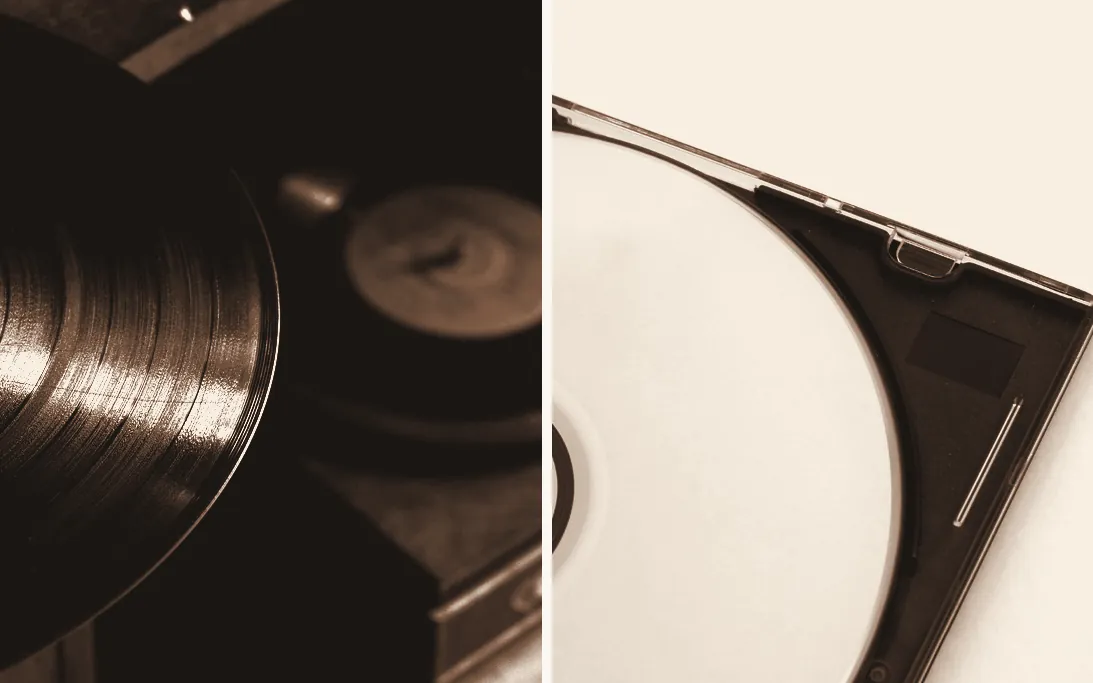
The vinyl versus CD argument has run for four decades without a winner, and it won’t get one here. The two formats are good at different things. A CD reproduces a digital master the same way on every play. A record turns that master into a physical groove, and the cutting lathe, the pressing and the turntable each shape what comes out.
For a buyer, the more useful finding is that the format is often not the biggest difference between two copies of an album. The master is. That turns “which format is better?” into “which copy of this album is better?”, and the answer can change from one album to the next.
What actually differs between the formats
A CD stores sound as 16-bit samples, 44,100 per second. On paper that gives a dynamic range of about 96 dB between the loudest possible signal and the noise floor. A record stores sound as a wavy groove traced by a stylus, and its usable range is usually quoted somewhere between about 55 and 70 dB, limited at the bottom by surface noise. By that measure the CD is the more accurate format, and it plays back identically every time.
Those ceilings rarely decide how an album sounds. Commercial masters sit far below either one: Earl Vickers’s survey of the loudness war, cited below, quotes one engineer putting the gap between peaks and average level at about 10 dB for analog-era pop and as little as 6 dB for loudness-war masters. What reaches the listener depends far more on decisions made in the mastering room. The table below sets out the practical differences.
| CD | Vinyl | |
|---|---|---|
| Playback | A laser reads the disc without touching the playing surface | A stylus rides in the groove |
| Noise between tracks | Silence | Faint hiss, occasional ticks |
| Deep bass | Can be fully stereo | Usually narrowed toward mono so the stylus can track it |
| Playing time | A whole album without a break | About 22 minutes a side at 33 rpm before the cut has to get quieter, then a flip |
| Quality across the disc | The same from first track to last | Softer highs toward the center of each side |
| Wear from playing | None from the laser | A little with every play, more with a dirty record or worn stylus |
Unrip’s free Format simulator lets a listener hear several of these effects on their own music, one at a time. It applies an illustrative model of a typical record and playback chain to a digital track. It is not a measurement of any real turntable or pressing, but it is a quick way to hear what the bass, the inner grooves and surface noise each contribute.
Why the master matters more than the format
Before music is pressed onto either format, a mastering engineer prepares it: setting the final tone, the level and how much dynamic compression is applied. The two formats push that work in different directions.
Vinyl imposes physical limits. In an interview with Copper magazine, vinyl mastering engineer Lewis Hopkin describes the main ones. Bass with wide stereo effects can’t be cut as it is, so it is kept mono below a certain frequency. Sibilant vocals create a groove shape a playback stylus can’t follow, which is why records are often de-essed. A louder cut needs wider grooves, so loudness and playing time compete; Hopkin suggests about 22 minutes as a sensible maximum for a side at 33 rpm, beyond which the cut has to be noticeably quieter. Fidelity also drops toward the center of a side, because the stylus covers less groove per revolution, which is why 45 rpm records, with their faster groove speed, can sound better.
CDs had no such brake. A digital master has a hard ceiling, but nothing stops the average level from being pushed right up to it with compression and limiting. Vickers’s 2010 paper for the Audio Engineering Society (AES), a survey of what has become known as the loudness war, cites figures suggesting that LPs rose in level by perhaps 4 dB over 40 years, while average CD levels rose by almost 20 dB in 20 years. The cost is dynamics: the gap between quiet and loud passages shrinks, and heavily limited masters can clip and distort. The same paper found only a very weak relationship between an album’s dynamic range and its sales, which undercuts the usual commercial reason for pushing levels up.
This is the source of a common observation: some albums sound more open on vinyl than on CD. Often that’s not the format, it’s a gentler master that was cut to suit the lathe. But it isn’t a rule. A 2016 article by Marc Henshall of Sound Matters notes that the vinyl and digital versions can share one master, and reports mastering engineer Ian Shepherd’s view that a loud, compressed master pressed to vinyl can sound even worse than the digital version. Henshall also points to examples that go the other way, such as the 2012 vinyl edition of Californication cut by Bernie Grundman, which he cites as having much better dynamics. The practical upshot is that each album, and each edition, has to be judged on its own.
Reading dynamic range figures without being misled
The Dynamic Range Database is a crowd-sourced list of DR scores for a very large number of releases, including many vinyl rips. It is the quickest way to see whether a particular CD issue or remaster was heavily compressed. Higher numbers mean more dynamic range.
The site’s own FAQ adds two cautions. A low score doesn’t automatically mean a bad-sounding album, nor a high one a good one; what counts as acceptable also depends on genre, with dense electronic music sounding fine at scores that would flatten a rock record. And the measuring tools differ, with an older free meter and a newer, more precise paid one, so scores aren’t always comparable.
Vickers’s paper gives an example of how big the gap between CD editions can be: the song Wicked Game measures DR 13 on Chris Isaak’s 1989 album Heart Shaped World and DR 7 on a 2006 best-of. For a buyer choosing between CD editions of the same album, the newest remaster is not automatically the best-sounding one.
What controlled listening tests show
Rigorous, published blind tests of vinyl against CD are surprisingly scarce. The two below answer different questions, one whether CD-standard audio audibly limits sound and the other how listeners perceive vinyl. Each has limits, and neither settles which format a particular person will enjoy more.
CD-standard audio holds up in blind tests. In a study published in the Journal of the Audio Engineering Society in 2007, E. Brad Meyer and David Moran inserted a CD-standard 16-bit, 44.1 kHz conversion stage into the playback of high-resolution recordings and asked listeners, including recording engineers and audiophiles, to tell the difference under double-blind conditions. At normal listening levels they could not. The difference became detectable only with very quiet passages played at greatly elevated volume, where the slightly higher noise of the CD stage could be heard.
Vinyl transfers were not preferred blind, but liked in person. In a 2015 study presented at an AES convention, Michael Uwins mastered his own material, had it cut to a one-off vinyl dub-plate with no extra processing, and played digitized excerpts to listeners in blind tests alongside digital versions. On average, the vinyl versions were rated lowest. In a second test, participants handled a record and a CD and listened to each, at matched loudness, and most who heard a difference preferred the record, even though both played identical audio. The study is small and used a dub-plate rather than a commercial pressing, which the author acknowledges, but it shows how strongly the sleeve, the turntable and expectations shape what people hear.
Louder sounds better, and that skews casual comparisons. As Vickers’s paper notes, when people hear the same music at two volumes, they almost always pick the louder one, partly because the ear hears more of the bass and treble at higher levels. Any comparison between a record and a CD that isn’t level-matched is mostly a comparison of volume. The Format simulator matches levels and includes a blind ABX mode for that reason.
None of this makes a preference for vinyl wrong. Listeners who like a record’s slightly softened treble, gathered bass and quiet background texture are hearing real differences. Whether those differences are improvements is a matter of taste, not measurement.
Cost, durability and convenience
Price. New records cost more. The RIAA’s 2025 year-end report on the US market puts vinyl at about $1.04 billion in wholesale revenue from 46.8 million units, and CDs at about $312 million from 29.5 million units. That works out to an average of roughly $22 per vinyl unit and $10.60 per CD before any retailer markup. Shelf prices vary widely by title and edition, but the gap gives a sense of the premium. On the used market the formats differ in another way: a used CD that plays cleanly sounds the same as a new one, while a used record’s sound depends on how it has been played and stored.
Durability. A guide for librarians and archivists published by CLIR and written by Fred Byers of NIST notes that CDs don’t wear from friction the way records and tapes do, because nothing touches the surface the laser reads. CDs are not indestructible, though. Their reflective metal layer sits just under the label side, protected by a thin lacquer, so a scratch on the label can do more damage than one on the shiny side. Heat and humidity can corrode that layer over time, and the same guide gives estimates for pressed discs that range from 20 to 100 years depending on conditions. Records, by contrast, wear a little with each play, more so with a dirty record or a worn stylus, and can warp if left somewhere hot.
Convenience. A CD plays in a car, on a computer drive or a portable player, runs a whole album without a break, and can be ripped to a digital library in a few minutes. A record needs a turntable, a phono stage, a clean stylus and a flip every side. For some listeners that ritual is the appeal; for others it is the reason they stopped buying records.
Collecting appeal
Sound is only part of why people buy physical music. A 12-inch sleeve shows artwork and liner notes at a size a CD booklet can’t match, and many reissues add gatefolds, inserts or colored vinyl. The Uwins study concluded that sound isn’t the only factor: preferences are strongly influenced by non-auditory ones, such as handling the record and the turntable. The market reflects it: in the RIAA’s 2025 figures, US vinyl sales passed $1 billion and outsold CDs in units.
CDs have their own collectors’ strengths. They are compact and light to ship, and for much of the 1990s the CD was the main format, so for music from that decade the CD is often the original release. Early CD issues also often predate the loudest remasters, though that is worth checking on the Dynamic Range Database.
Choosing album by album
Is one format’s master known to be different?
Search the album on the Dynamic Range Database and on collector forums. Compare CD editions with each other first; treat a high vinyl score as a lead to check, not a verdict.
How long is each side?
A single LP holding much more than about 22 minutes a side has to be cut quieter. Long albums spread across two discs, or 45 rpm editions, avoid that compromise.
Is the price gap worth it for this album?
At wholesale, a new record averages about twice the price of a CD. For an album played mostly in the car or ripped to a phone, the CD is often the practical choice; for one played start to finish at home, the record may earn its premium.
Will it be played a lot?
A CD survives heavy play unchanged. A record will too if the stylus is clean and in good shape, but it should be handled by the edges and stored upright, away from heat.
Can the difference be heard at matched levels?
Trying the Format simulator in blind mode is a quick, free way to learn which differences a listener personally responds to, before paying for a second copy of an album.
Is it a used copy?
A used CD is usually a safe buy if the shiny side and label side are free of deep scratches. A used record depends on its grade; the buying guide explains how to read condition grades.
Sources & further reading
- The Loudness War: Background, Speculation and Recommendations — Earl Vickers, AES 129th Convention
- How Does a Vinyl Record Even Sound Good at All? Talking With Lewis Hopkin, Vinyl Mastering Engineer, Part Two — Copper magazine
- Measuring Vinyl Dynamic Range: It’s Complicated! — Sound Matters
- FAQ — Dynamic Range DB
- Audibility of a CD-Standard A/D/A Loop Inserted into High-Resolution Audio Playback — Boston Audio Society
- Analogue Hearts, Digital Minds? An investigation into perceptions of the audio quality of vinyl — Michael Uwins, AES 138th Convention
- Year-End 2025 Music Industry Revenue Report — RIAA
- Care and Handling of CDs and DVDs: A Guide for Librarians and Archivists — CLIR and NIST